
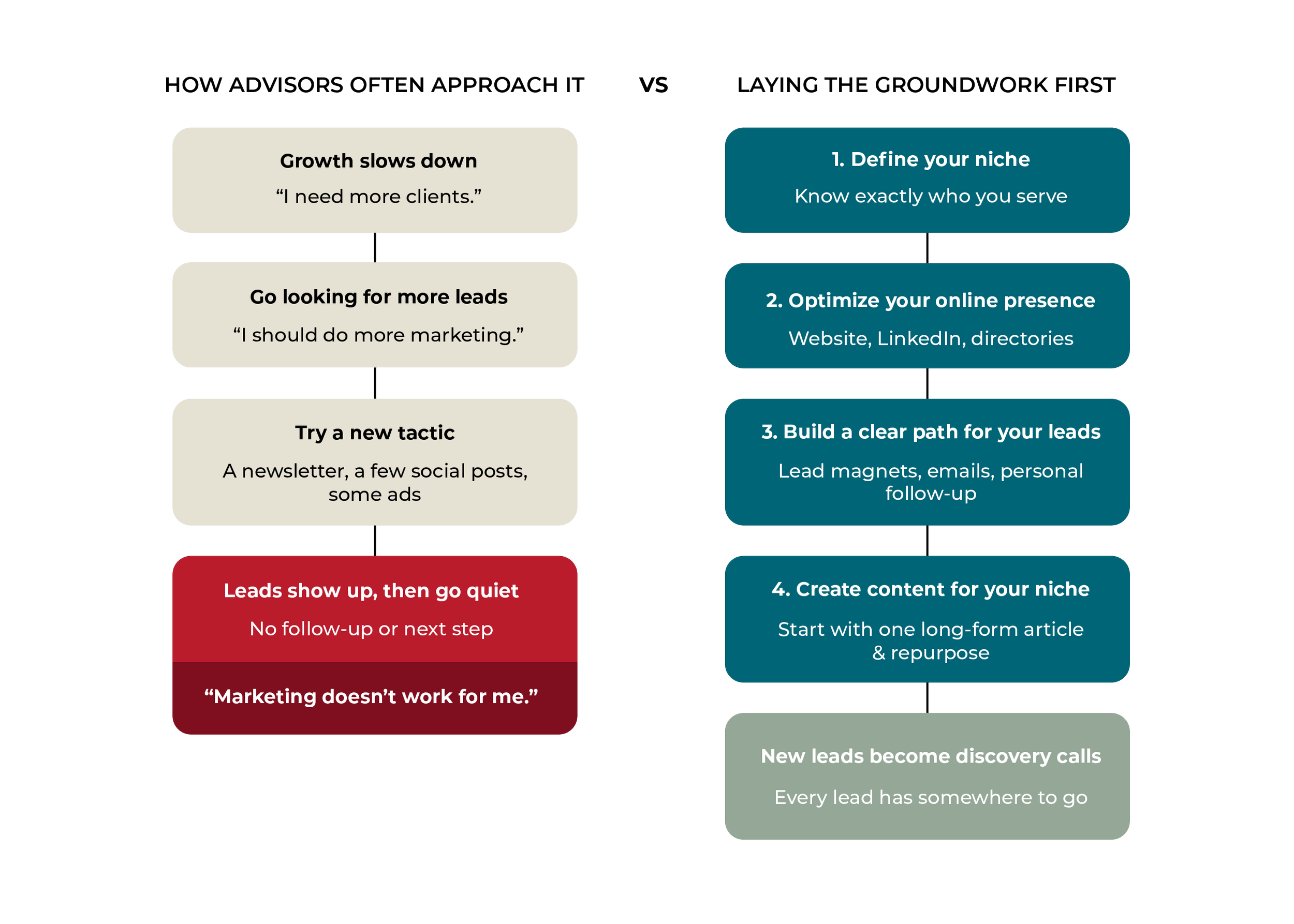
When growth slows, most financial advisors think, “Hey, I need more leads. And if I need more leads, I guess I need more marketing.”
When you’ve watched other advisors grow online and know referrals can’t carry you forever, that’s totally understandable.
So you start up a newsletter. You might post on LinkedIn for a few weeks, or pay for a directory listing, or try out a round of ads. A couple of leads come in, then go quiet.
Maybe marketing just doesn’t work for you. 🤷🏼♀️
Your efforts aren’t wasted. It’s just that before you go looking for more leads, you need a way to catch, keep, and move the ones you already have.
Think about the referral who Googles you and finds a LinkedIn profile that hasn’t been updated in five years, or put yourself in the shoes of a prospect who downloads your guide and never hears from you again.
Both were interested, but they didn’t know what to do next.
This financial advisor marketing guide walks through the order we recommend at Moneta:
Figure out where you are
Define your niche
Get your online presence ready for the people looking for you
Build a path that moves leads toward a discovery call
Then create the content to reel in the new ones.
start by figuring out where you are
How you think about marketing depends on how much you’ve built online so far. An advisor with a 15-year referral book and a bare-bones website is in a different position, facing different problems, than a two-year-old firm that’s posting every day without seeing conversions.
Give your position a hard, honest look and see what sounds most like you:
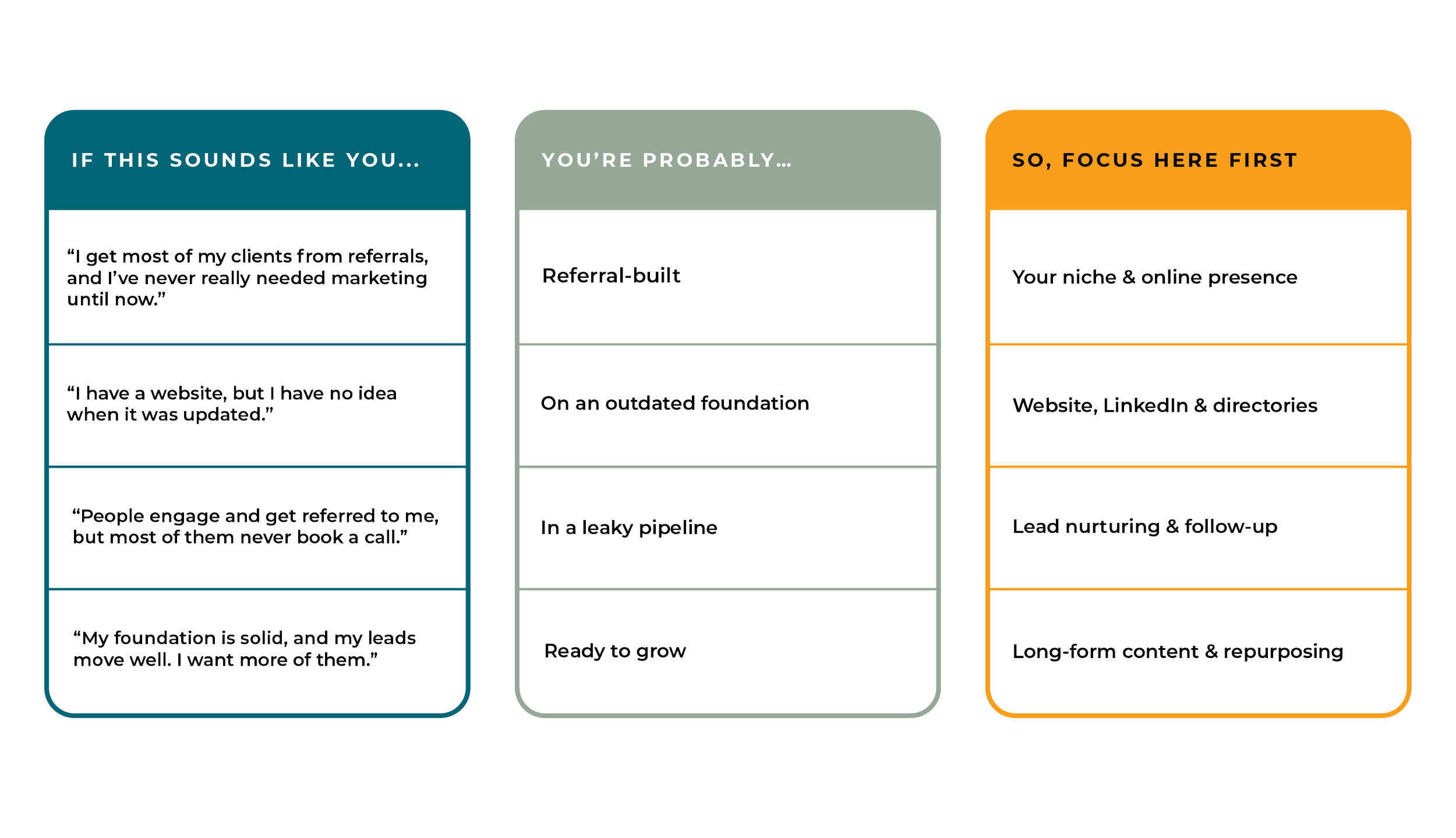
Wherever you are, you have a clear place to start. The following phases all build on one another, so even if you’re in the last row, a quick look at all four phases can help your content work harder for you once you start publishing.
phase 1: pick a niche you can own
Every single piece of your marketing strategy hinges on knowing exactly who you serve. Your website copy, LinkedIn profile, and all the topics you write about get easier once your audience is clear.
A niche can take a few different forms:
Local. You’re the go-to advisor for a specific city or region, and you show up when people in that area search.
Professional. You serve a particular type of client, like physicians, tech employees with equity compensation, or skilled trades business owners.
Life stage or event. You’re the one who gets people through a divorce, inheritance, or the five years before retirement.
If you’re not sure where to start, pull up your five favorite clients and your five most recent ones. Look at what they have in common. The overlap usually points to the niche that’s already finding its way to you.
MARKETING VS. BUSINESS DEVELOPMENT VS. SALES
I do want to make clear a few things advisors tend to lump together, which are marketing, business development, and sales.
Marketing is everything that gets the right people to know you exist and develop trust in your brand. In financial services, the role of marketing is to expand awareness of your brand and services, as well as speed up the conversion process with leads who book calls because they’re already pre-educated and pre-sold on working with you.
Business development includes the actions you take to turn your marketing efforts into booked calls. It involves following up with people who engage with your content or profiles, intentionally networking with your ideal clients, and developing referral relationships and strategies.
Sales is the process that turns a booked discovery call into a client, which includes the conversation itself, the proposal or offer, and the follow-up that happens after a call.
A strong niche strengthens all three by telling your marketing and business development where to aim and giving your sales conversations a head start because your prospects already believe you understand people just like them.
71% are specifically looking for information on cost, fees, and commissions on your site. And believe me, I can already hear the pushback. “If I put my fees on my website, people will just choose the cheapest option!”
The old strategy was to hide the information so they’d be ‘forced’ to book a call and find out. Then, you’d be able to sell them on the value before hitting them with the fee.
That strategy does not work anymore.
Nobody wants to get half an hour into a discovery call expecting to pay $7,000 a year, only to find out your fee is $25,000. The reverse is true as well. An advisor who charges $3,000 a year can appear too cheap when the prospect was expecting $7,000.
And fees are just one data point. The instinct to “check before they call” extends to your investment philosophy, your niche, and what the process looks like between a first call and signing on.
phase 2: prepare your online presence for referrals
Old-school strategies like referrals, centers of influence, and a firm handshake still work. I know many advisors who still use them, and with great success. What’s changed, though, is what happens between the referral and the first call.
Today, when a happy client passes your name along, their friend opens a search bar before they even think about dialing your number. They look at your website and check your LinkedIn. They might look for you in a directory like XY Planning Network, NAPFA, or a local listing.
Your credentials and experience matter, but they want to find out whether you’re the right fit for them.
At this stage, your online presence has one job: sell that referral on you. Here’s where to focus:
Your website. Read your homepage as if you were a stranger. It should only take a quick second to tell who you help, what problems you solve, and what to do next. And if your headline could belong to any other advisor in the country, it needs work. Name your niche, use a real photo of yourself, and make booking a call ridiculously easy to find.
Your LinkedIn profile. Referrals likely end up here next, and it’s often neglected. Update your headline so it names who you serve, rewrite your About section in your own voice, and make sure your photo and banner reflect the person clients will meet.
FROM OUR RESEARCH
Earlier this year, we co-commissioned a study to survey more than 100 prospects who were actively looking for a financial advisor. Our findings show that 35% of first-time advisor prospects move on to another advisor when they can’t find the answers they’re looking for on a website, rather than reaching out to ask.
They want to see things like your fees, your investment approach, and testimonials from people like them before they ever book a call.
Read the full 2026 Financial and Wealth Advisory Prospect Preferences Report, or listen to the authors unpack the findings on this episode of The Finance Marketing Podcast.
Your directory listings. Directories can send steady, high-intent traffic, but your profile has to do that work. Fill in every field, mirror the niche language from your website, and link to a page where people can take a clear next step.
Consistency across all three. A prospect who sees “retirement planning for educators” on your website, “wealth management” on LinkedIn, and a blank on a directory doesn’t know which version is real, and they don’t have the time to figure it out on their own. Pick the message that matches your niche and use it everywhere.
phase 3: build a path for leads you already have
Before you invest in marketing to bring in new people, you need to be ready to do something with them when they show up. Skipping this phase is where the “marketing doesn’t work for me” feeling usually comes from.
Here’s what a simple path from first contact to discovery call can look like:
A clear next step on every page. Each webpage should point somewhere, whether to book a call, download a guide, or join your newsletter.
A lead magnet designed for your niche. It could be a checklist, guide, or short assessment that gives people who aren’t ready to talk a reason to share their email.
A welcome email sequence. Think three to five emails that introduce you, share your unique POV or approach, and invite a conversation. You write it once, but it works for every new subscriber.
A regular newsletter. Monthly is plenty for most advisors. It keeps you top of mind for the months (or years) it can take for someone to be ready to reach out.
A personal follow-up. Automation can do so much for advisors, but it’s not for everything. A quick, personal note after a referral introduction or a webinar goes a long way, especially when most of their inbox is automated.
Once these pieces (or ones like them) are in place, every lead, wherever they are in your pipeline, has somewhere to go. At that point, bringing in more leads starts to pay off.
phase 4: create content for your niche
Niche defined, foundation updated, and path in place: now you’re ready to create content.
The best place to begin is with a single long-form article. Around 1,500 to 2,000 words is plenty, but the word count is less important than the substance. Whatever you write about, it should answer a real question your ideal client has while giving you three things:
Something to rank for. When your niche Googles their biggest money questions, or asks an AI tool like ChatGPT, you want your answer to be there. A financial content writer can help you find the phrases your audience searches and build each article around them naturally.
Something to send. A thoughtful article is a great follow-up after a discovery call or referral introduction. It shows prospects how you think before they sit down with you.
Something to repurpose. One solid article has enough material for weeks of other content, like social posts or newsletter features.
ONE ARTICLE, MANY APPLICATIONS
Here’s how a single long-form post on, say, Roth conversions before taking Social Security benefits, can stretch across your marketing efforts:
Three or four LinkedIn posts, each pulling out a different idea or key point from the article
A section in your monthly newsletter with a link to the full post
A short video where you walk through the most common mistakes you see
A talking point for your next podcast spot or speaking event
A starting point for a lead magnet checklist or assessment
You do the deep thinking and writing once, but your ideal clients see your expertise at each point of contact.
Once that first article goes live (congrats, that was the hardest part!), these three habits will help you keep going and make sure the right people find your content.
1. PICK ONE PLATFORM. STICK WITH IT.
There are tons of social media platforms, and not all of them are worth your time or effort. Pick one platform you can get really good at, build the habit, and add a next one (if it makes sense) later. I also say choose one you can actually enjoy. If you have to drag yourself to it every day, it’s hard to stay consistent and engaged.
2. WRITE FOR THE QUESTION PEOPLE ARE ASKING AI.
So many prospects these days ask ChatGPT or see Google’s AI overview when they’re looking for an advisor. I suggest typing in a prompt the way your ideal client would, like “I’m a [your niche] looking for a financial advisor who [what you do].”
Take special note of the follow-up questions the tools ask back, then write content that answers them. (If you want more on this, I dug into adapting content for AI search with Kali Roberge of Beyond Your Hammock in this podcast episode.)
3. BE PATIENT
Organic content usually takes 12 to 24 months before it builds up momentum. While your content grows your audience, your follow-up system keeps leads from slipping away.
how moneta advisor marketing helps at every phase
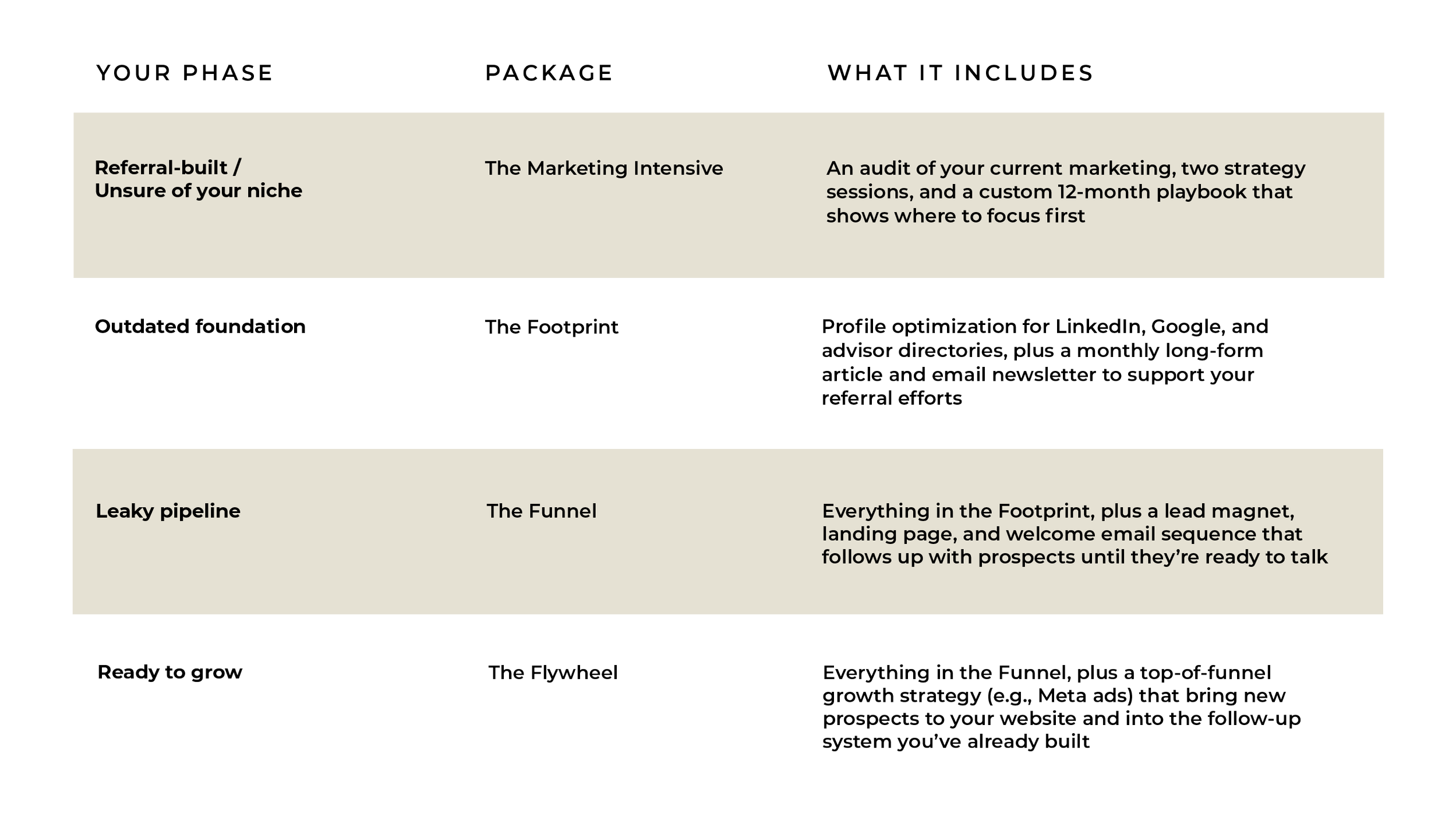
Wherever you’re starting, we can meet you there. As a financial marketing agency that works only with advisors, coaches, and other finance pros, we’ve built our services to follow the strategy laid out here.
get ready, then get found
Think back to that newsletter you wanted to get off the ground, or those couple of weeks of LinkedIn posts before the momentum dwindled. Once your niche is clear, your presence is updated, and you have a follow-up path in place, that same effort finally has a clear focus and somewhere to go.
Imagine how different things would look if the referral who looks you up immediately sees an advisor who clearly understands people like them, or if the prospect who downloads your guide hears from you the following week. Maybe they book a call the week after that, too.
If you’re not sure which phase you’re in, or if you know exactly where you’re stuck and want help getting unstuck, let’s talk.
Book a discovery call, and we’ll map out what your marketing plan should tackle first.
And if you want more real-world stories from the professionals who’ve lived this, I talk with advisors, coaches, and marketing experts about what’s working for them every Friday on The Finance Marketing Podcast.
At Moneta Advisor Marketing, we specialize in financial marketing strategy and services for financial advisors, coaches, and industry professionals who want to grow their practice through thought leadership.