
56% of Prospects Move On After Visiting Your Website. Here’s Why.
key takeaways
44–56% of prospects will leave your website and move on to another advisor if they can't find the information they're looking for.
The number-one reason prospects pass on an advisor is that the advisor sounded just like everyone else they researched.
71% of prospects are specifically looking for fee information on your website.
It’s hard to know whether your website is really doing its job. Prospects who don’t like what they see don’t call to tell you why — they just move on to another advisor’s site.
So we decided to ask them directly.
Earlier this year, John Way, Katie Lantukh, and I surveyed 100+ high-income Colorado prospects who were actively researching financial advisors. We wanted to understand what happens between “I need an advisor” and “I booked a call.”
What we found was that, depending on how long they’ve been searching, 44–56% of prospects will just move on if they can’t find the information they’re looking for on your website.

And that’s true regardless of how leads come to you, including referrals.
your referrals are shopping around
If most of your business comes from referrals, you might assume your website doesn’t have to work very hard.
But your referrals aren’t just looking you up. Now they’re taking the opportunity to look up a few more advisors as well.
Our study found three distinct types of prospects doing this research right now:
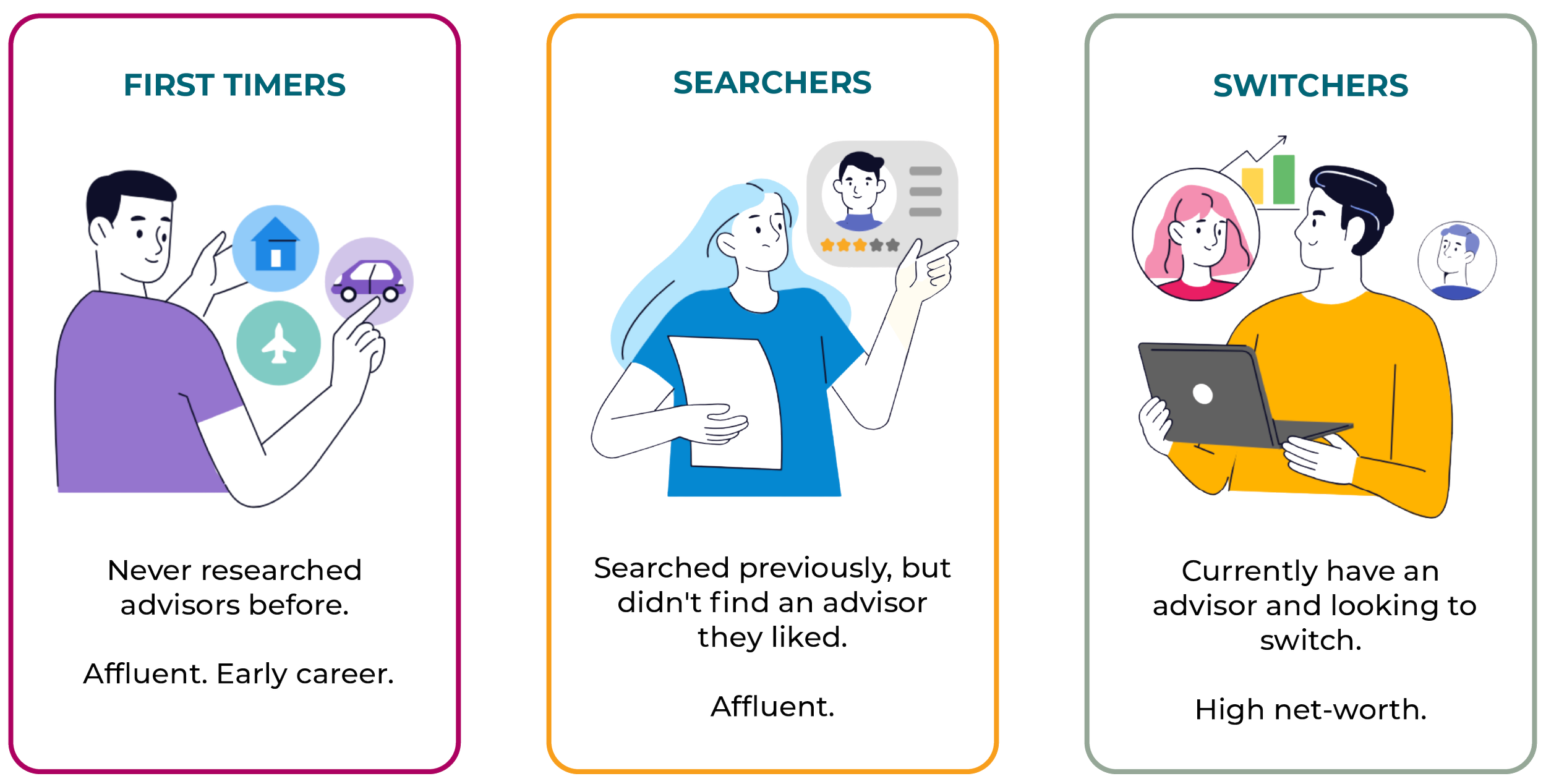
The good news is that 45% of First-Timers and 47% of Switchers ultimately chose an advisor who was already on their shortlist. Being referred is still the strongest position you can be in.
But that means more than half of the prospects who had you on their list still didn’t book a call.
So what’s going wrong between “I’ve heard of this advisor” and “I want to talk to them”?
what prospects want to see on your website

71% are specifically looking for information on cost, fees, and commissions on your site. And believe me, I can already hear the pushback. “If I put my fees on my website, people will just choose the cheapest option!”
The old strategy was to hide the information so they’d be ‘forced’ to book a call and find out. Then, you’d be able to sell them on the value before hitting them with the fee.
That strategy does not work anymore.
Nobody wants to get half an hour into a discovery call expecting to pay $7,000 a year, only to find out your fee is $25,000. The reverse is true as well. An advisor who charges $3,000 a year can appear too cheap when the prospect was expecting $7,000.
And fees are just one data point. The instinct to “check before they call” extends to your investment philosophy, your niche, and what the process looks like between a first call and signing on.
why prospects pass on advisors (even those on their shortlist)
When we asked prospects why they passed on an advisor — even one who was already on their shortlist — the number one reason for First-Timers and Switchers was that the advisor sounded just like every other advisor they researched.
Nothing said, “This person completely understands people just like me. They get it.”
(They did not pass because of cost, credentials, or years of experience.)
Having looked at hundreds of advisor websites myself, I know why they’re saying this.
“Comprehensive financial planning.”
“We help you achieve financial freedom.”
“We start with your goals.”
“Retire on your terms.”
John Way put it well on the upcoming podcast episode we recorded about this study.

That’s exactly what the data shows prospects doing.
what happens when you’re different
Compare that to an advisor I work with who serves tech sales professionals. His homepage skips the generic language entirely, starting with “I help tech sales leaders not blow their commission checks.”
That's not something five other advisors could say word-for-word. A sales pro reads that and knows immediately whether this advisor gets their specific situation.
If your site sounds like it could belong to any advisor in your zip code, you're giving prospects zero reason to pick you over the next name on their list, even the ones who already had you at the top.
WANT TO HEAR THE FULL CONVERSATION?
Listen to the episode: The #1 Reason Prospects Pass On Advisors (It’s Not Your Fees)
does your website pass the test?
If you’re already on someone’s shortlist — most likely because they were referred to you — your site’s job is to confirm the decision they’re already leaning toward. Don’t stall it out with a missing fee schedule or an unanswered question.
If you’re trying to reach a prospect who’s never heard of you, your site has to do all the trust-building on its own. And those strangers may not even visit your site directly. 30% of Searchers told us they ask AI rather than asking you. AI tools pull their answers from whatever your site says.
When your site doesn’t say it, they don’t leave the question blank. They guess, and that guess becomes someone’s first impression.
Either way, start by looking at your own website as a first-time visitor would: phone in hand, deciding in about ninety seconds whether you're worth a call.
Ask yourself:
Can someone figure out your fees, or at least your general pricing approach, without talking to you first?
If a stranger reads your homepage next to four competitors, would anything on it sound uniquely you, or could all five sites be interchangeable?
Is there anything on your site today that reads like gatekeeping instead of an answer?
If an AI tool summarized your practice right now, would it get your specialty, your minimums, and your process right?
We built a free AI diagnostic tool that evaluates your website based on this criteria, using the same research from our study.
It checks your site against the things buyers said matter — cost transparency, findability, and the completeness of information from AI tools — so you can see where your site is likely losing prospects before they ever reach out.
frequently asked questions
Q: WHERE DOES THIS DATA COME FROM?
This data comes from a 2026 study I co-authored with John Way and Katie Lantukh. We surveyed 100+ Colorado prospects with household incomes of $100k–$200k+ and investable assets of $250k–$5M+ who actively researched financial advisors between January and June 2026. You can view the full study here.
Q: DO I REALLY NEED TO PUT MY FEES ON MY WEBSITE?
You don’t need to list exact dollar amounts, but prospects need enough to know whether you’re in their ballpark. When fee information is missing entirely, most prospects don’t call to ask. They move on or they guess, and neither outcome works in your favor.
Q: WHAT IF MY LEADS MOSTLY COME FROM REFERRALS?
Referrals put you in the strongest position — 45–47% of prospects chose an advisor already on their shortlist. But your referrals are comparing you to other advisors they find during their research, so your website still needs to get the call booked.
Q: WHAT IS AEO AND WHY DOES IT MATTER FOR MY WEBSITE?
When prospects can’t find answers on your site, 30% of Searchers told us they ask AI tools for the information they’re looking for. Those tools pull from whatever your site says. When it doesn’t provide answers, the tools may fill in the blanks on their own. Making your site clear and comprehensive helps ensure AI represents your practice accurately.
At Moneta Advisor Marketing, we specialize in financial marketing strategy and services for financial advisors, coaches, and industry professionals who want to grow their practice through thought leadership.